Buddy Hanson's motivational writing style is a tremendous asset in helping one see the need to actually live out God's law, instead of being content just to learn about it.
Hanson's organization is "Grace and Law Christian Policy Network." Hanson's books can be ordered here, and articles by Hanson can be read here. To receive Hanson's weekly theonomic motivational e-mail, contact Hanson at bhanson@graceandlaw.com.
Two excellent books by Hanson include "God's Ten Words: A Commentary on the Ten Commandments," and "The Christian Prince," about biblical versus Machiavellian civil government.

Showing posts sorted by relevance for query buddy hanson. Sort by date Show all posts
Showing posts sorted by relevance for query buddy hanson. Sort by date Show all posts
Thursday, January 7, 2010


Thursday, January 26, 2012
IF (part two)
By Buddy Hanson
IF
IF
IF
IF
Last week we looked at seven Spiritual Mind Expanding thoughts designed to remind our brothers and sisters in Christ of their commanded duties as a member of God’s family and Christ’s Kingdom. This week we add six more IF’s to share with your friends. Remember to write down any IF’s you think of and send them in. If we have enough to publish in a Part Five, we’ll do so.
IF
We continue to live as though God’s Word doesn’t exist by hiding it “under a basket,” how will our neighbors “see our good works and glorify our Father in heaven?” (Matt. 5.15-17) Do we not have numerous promises from God that He will use our obedience to confound our opponents in His perfect timing? (1 Cor. 1.27)
IF
We really believe that God created an orderly cause-and-effect creation, then we agree that the only way we, and other Christians across the world, can bring about positive results is to live according to God’s truths, instead of man’s lies.
Our pastors don’t begin to systematically instruct us in how to apply the truths of Scripture to our everyday situations and circumstances, how can we expect to demonstrate lifestyles that are distinctively different from that of our non-Christian neighbors? (Romans 12.1-3) And
Our daily goal is not to “bring glory to God in all we do and say” (1 Corinthians 10.31), aren’t we imaging Satan, instead of Christ?
This is the case, are we not testifying that we are merely a well-intentioned, but misguided and pragmatic conservative moralist, instead of a Christian whose life on earth, as well as our eternal existence, is based upon our subjective imaginings of how to live, rather than upon the objective truths on the pages of our Bible? And,
This is the case, why bother to go to church or study the Bible, when for all intents and purposes, we have decided that each of us is, in effect, our own mini-god? (Rom. 1.25-26)
(Scripture quotes may be paraphrases)
Buddy Hanson is President of the Grace & Law Resource Center, which helps fellow Christians provide a visual model of what a redemptive world will someday look like by assisting them to re-suppose what they pre-suppose by interpreting the Bible in terms of our present days, instead of according to the last days. www.graceandlaw.com, 205.454.1442
Buddy Hanson is President of the Grace & Law Resource Center, which helps fellow Christians provide a visual model of what a redemptive world will someday look like by assisting them to re-suppose what they pre-suppose by interpreting the Bible in terms of our present days, instead of according to the last days. www.graceandlaw.com, 205.454.1442
To send in more IFs, contact Buddy Hanson at bhanson@graceandlaw.com. If enough are received, Hanson plans to incorporate them into a Part Five.
Wednesday, January 18, 2012
IF (part one)
By Buddy Hanson
(Scripture quotes may be paraphrases)
Buddy Hanson is President of the Grace & Law Resource Center, which helps fellow Christians provide a visual model of what a redemptive world will someday look like by assisting them to re-suppose what they pre-suppose by interpreting the Bible in terms of our present days, instead of according to the last days. www.graceandlaw.com, 205.454.1442
Once more it’s the height of the political season, and once more Christians are disappointed in the candidates that have emerged. There is something very puzzling about this. In the first place why should we be surprised that, after sitting on the sidelines waiting for a random act of kindness on behalf of non-Christians to offer up a slate of explicitly Christian candidates? For example, how many churches have provided weekend seminars for local candidates and legislators (and their members!) on how a Christian civil ruler should legislate? In the second place, the Bible promotes the personal liberty of self-government, not the tyranny of central government, so why are we more interested in what a president might do, than we are in what we should do?
Rather than continuing to preach to the choir, I thought a more effective tactic would be to provide a series of brief Spiritual Mind Expanders. Perhaps you can use them with your Christian friends to arouse their interests and awaken them to some ways to bring honor to their Lord, Savior, and King, Jesus Christ in all they do. Since this is not in any way a complete list of “IF’s, you may think of additional ones. If so, send them in after Part Four (at bhanson@graceandlaw.com),and if we have enough to send out a Part Five, we’ll do so.
Following are the first seven IF’s. Enjoy!
IF
We really believe that God’s Word is true and without error,
IF
We really believe that man’s word, when it doesn’t conform to God’s Word is false, then aren’t we agreeing that ONLY God’s Word works, and that man’s word ONLY fails?
IF
This is the case, then why do we spend even a millisecond considering which candidate to vote for?
IF
They don’t believe that Jesus is "the way, the truth, and the life, and that no one comes to the Father except through Him?" (John 14.6)
IF
They don’t believe this, they will seek counsel from people who hate the triune God of Scripture and will make decisions based upon the self-centered and sinful wisdom of man, instead of the others-centered and holy wisdom of God.
IF
We vote for the lesser of two evils, are we not disobeying the apostle Paul’s admonition to “overcome evil with good” (Romans 12.21), and at the same time, “resisting the ordinance of God,” causing Him to appoint evil rulers over us, instead of godly rulers? (Romans 13.1-7)
IF
We blatantly disobey God’s counsel on how to select civil rulers, upon what basis can we expect Him to “hear our prayers” to turn our country back to living according to biblical ethics? (Isaiah 1.15)
(Scripture quotes may be paraphrases)
Buddy Hanson is President of the Grace & Law Resource Center, which helps fellow Christians provide a visual model of what a redemptive world will someday look like by assisting them to re-suppose what they pre-suppose by interpreting the Bible in terms of our present days, instead of according to the last days. www.graceandlaw.com, 205.454.1442
To send in more IFs, contact Buddy Hanson at bhanson@graceandlaw.com. If enough are received, Hanson plans to incorporate them into a Part Five.
Friday, February 3, 2012
IF (part three)
By Buddy Hanson
It’s been said that the problem with living a Christian life isn’t what we don’t know, but what we do know. Since the lifestyle of the typical American Christian is virtually identical to that of our non-Christian neighbors, its apparent that many of our Christian friends are unintentionally “suppressing the truth in unrighteousness” (Rom. 1.18). In Part Three of IF we take a brief look at four additional bottom-line obedience questions. Share them with your friends, and remember to make a note of any “IF” you would like to add, and after this series ends next week, send it in. If we get enough to publish a Part Five, we’ll do so.
On the other hand,
On the other hand,
IF
We really trust-in God more than ourselves, why are we so hesitant to take a faithful stand for Him, by making certain that the textbooks our children are studying, the civil laws we live by, and/or the business practices we follow are founded upon His revealed ethics. After all, do we not believe that if any topic does not conform to God’s Word, it is a lie, and if followed, will only fail?
IF
Our church is not teaching that we have been adopted into God’s family and Christ’s Kingdom to be Spiritual elves to serve God by providing a visual model of what a redemptive world will one day look like, instead of viewing God as a Spiritual Santa Claus to serve our whims, what else is it teaching?
IF
We’re allowing subjective speculation about eschatology to override the truths and counsel of God’s clear objective revelation, we’re playing into Satan’s deceptive tactics to minimize our effectiveness as adopted servants in God’s family and Christ’s Kingdom. Instead we should be assisting fellow Christians to re-suppose that they pre-suppose by interpreting the Bible in terms of our present days (that the correct way to approach Bible study is to find objective ideas on how to apply the truths we are studying to our current situations and circumstances), instead of according to the last days.
IF
Our Bible teachers are not systematically instructing us in what the Kingdom of God is and what our roles are, how can we be expected to obey Jesus’ command to “seek first the Kingdom of God and His righteousness?” (Matthew 6.33)
(Scripture quotes may be paraphrases)
Buddy Hanson is President of the Grace & Law Resource Center, which helps fellow Christians provide a visual model of what a redemptive world will someday look like by assisting them to re-suppose what they pre-suppose by interpreting the Bible in terms of our present days, instead of according to the last days. www.graceandlaw.com, 205.454.1442
Buddy Hanson is President of the Grace & Law Resource Center, which helps fellow Christians provide a visual model of what a redemptive world will someday look like by assisting them to re-suppose what they pre-suppose by interpreting the Bible in terms of our present days, instead of according to the last days. www.graceandlaw.com, 205.454.1442
To send in more IFs, contact Buddy Hanson at bhanson@graceandlaw.com. If enough are received, Hanson plans to incorporate them into a Part Five.
Tuesday, November 15, 2011
Second Edition of "God is Just: A Defense of the Old Testament Civil Laws" now Available
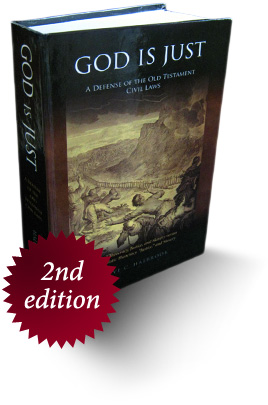
"Great book. At age 58, and someone who embraces Reformed theology, I was surprised to find myself shaken by the fear of God while reading this book. May God grant us as Christians repentance and faith to demand a return to the perfect law of God in America ."
— Michael Sawyer
"With God’s grace, God Is Just: A Defense Of The Old Testament Civil Laws will be used to bring American Christians to repentance and back to honoring God’s Word through their daily decisions."
— Buddy Hanson, Grace and Law Christian Worldview Resource Center
"'God is Just' covers a very important set of topics: the applicability of God's law to civil society. Contrasting the perfection of God's law with the tyranny of modern law, Stephen Halbrook presents a well-reasoned and well documented case for God and His law.
"No one, including myself, will agree with everything in the book (I disagree with his cavalier dismissal of the levirate and land laws, for example; as well as his entire treatment of female slaves) but that must be expected in a book of such length. These books all must be more of the beginning of a discussion than the be all and end all.
"This book should prove useful both as an introduction for those Christians who are confused or uninformed about the role of God's law in civil society and a valuable resourced for those of us already committed to the theonomic thesis."
— Vaughn Ohlman, The Practical Theonomist
Hardcover version

Download version
For ongoing information about the book, join us on Facebook!
___________________________________________________________________________________________
About God is Just: A Defense of the Old Testament Civil Laws: Biblical Theocracy, Justice, and Slavery versus Humanistic Theocracy, "Justice," and Slavery
About the Author
Steve C. Halbrook writes for, and manages, the blog Theonomy Resources. He holds an M.A. in Government from Regent University’s Robertson School of Government (2008), with a focus on biblical civil government. Halbrook’s master’s thesis was “God is Just: A Defense of the Old Testament Civil Laws,” which this book is an expansion of.
Chapter 12: Authority for Criminal Punishment
Part Three: Biblical Slavery versus
Humanistic Slavery
Bibliography
Scripture Index
Read excerpts in our archive here.
___________________________________________________________________________________________
About God is Just: A Defense of the Old Testament Civil Laws: Biblical Theocracy, Justice, and Slavery versus Humanistic Theocracy, "Justice," and Slavery
This book is a defense of biblical civil law, on topics despised not only by humanists, but by professing Christians. It is, in short, theonomic apologetics. God is Just takes our culture and its attacks on the Bible to task. It defends biblical theocracy, justice, and slavery, and cuts humanistic opposition down to size by its own self-destructive foolishness, and, most importantly, by the sword of God’s word.
In addition, the book includes appendices defending theonomy biblically and historically, as well as appendices refuting alternative political philosophies.
God is Just includes contributions from two of the most prolific next-generation theonomic writers, Buddy Hanson and Daniel F. N. Ritchie. Hanson (of Grace and Law Resource Center) wrote the forward, and Ritchie (of Reformed Worldview Books) wrote an appendix.
Additionally, the second edition includes a new appendix by Vindiciae Legis, who gives an excellent historical treatment of the theonomic views of the Westminster divines. Legis has previously written defenses of historical theonomy for Theonomy Resources.
About the Author
Steve C. Halbrook writes for, and manages, the blog Theonomy Resources. He holds an M.A. in Government from Regent University’s Robertson School of Government (2008), with a focus on biblical civil government. Halbrook’s master’s thesis was “God is Just: A Defense of the Old Testament Civil Laws,” which this book is an expansion of.
Table of Contents:
Forward (by Buddy Hanson)
Introduction
Forward (by Buddy Hanson)
Introduction
Part One: Biblical Theocracy versus
Humanistic Theocracy
Humanistic Theocracy
Chapter 1: What is Biblical Theocracy?
Chapter 2: Biblical Theocracy is not Ecclesiocracy
Chapter 3: Humanistic Church/State Fallacies
Chapter 2: Biblical Theocracy is not Ecclesiocracy
Chapter 3: Humanistic Church/State Fallacies
Chapter 4: The Neutrality Myth
Chapter 5: The Tyranny of “Neutrality”
Chapter 6: “Neutrality” Condemned by the Bible
Chapter 11: Only Two Theocratic Choices
Part Two: Biblical Justice versus
Chapter 6: “Neutrality” Condemned by the Bible
Chapter 7: All Law is Religious
Chapter 8: All Law is Theocratic
Chapter 9: Is Biblical Theocracy “Christian Fascism”?
Chapter 10: Faith and Imposition
Part Two: Biblical Justice versus
Humanistic "Justice"
Chapter 12: Authority for Criminal Punishment
Chapter 13: Eye for Eye
Chapter 14: Questioning God’s Justice
Chapter 15: Primitive Humanistic Injustice
Chapter 15: Primitive Humanistic Injustice
Chapter 16: Purge the Land
Chapter 17: Privacy “Rights”
Chapter 17: Privacy “Rights”
Chapter 18: “Controversial” Capital Sanctions: Blasphemy
Chapter 19: “Controversial” Capital Sanctions: Seduction to Idolatry
Chapter 20: “Controversial” Capital Sanctions: Sabbath-Breaking
Chapter 21: “Controversial” Capital Sanctions: Rebellion Against Parents
Chapter 22: “Controversial” Capital Sanctions: Sodomite Acts
Chapter 22: “Controversial” Capital Sanctions: Sodomite Acts
Chapter 23: Old Testament Capital Punishment Methods
Chapter 24: The Question of Abuse
Chapter 24: The Question of Abuse
Part Three: Biblical Slavery versus
Humanistic Slavery
Chapter 25: Old Testament Slave LawsChapter 26: The Rod and Abuse
Part Three Epilogue: The One True Liberator
Conclusion
Chapter 27: Humanistic Criticisms of Biblical Slavery
Chapter 28: Slavery Inescapable
Chapter 29: What About Racism?
Chapter 30: Enslavement to God versus Enslavement to the State
Chapter 31: Humanists Seek to Enslave Others
Conclusion
Appendices
Appendix A: The Biblical Basis for the Old Testament Civil Code’s Abiding Validity
Appendix B: Answering Objections to Keeping the Old Testament Civil Code Today
Appendix C: What About Natural Law?
Appendix D: Conservatism, Liberalism, Libertarianism, and Moderatism
Appendix E: The Christian Right
Appendix F: Is the Rape of an Unbretrothed Virgin a Capital Offense?
Appendix G: The Bond of Law: A Theonomic Reply to “The Bond of Love” (by Daniel F. N. Ritchie)
Appendix H: Understanding the Westminster Confession of Faith, Section 19.4, on the Judicial Law and General Equity (by Vindiciae Legis)
Bibliography
Scripture Index
Read excerpts in our archive here.
___________________________________________________________________________________________
About the Second Edition
We did not originally intend to release a second edition so soon. However, after deciding to change printing companies, we thought we'd go ahead and make a few updates in the process.
Besides some minor editorial changes, the main difference between the first and second edition is that the second edition has a textbook-style cover (as opposed to the first edition's removable cover), a Scripture index, and an appendix that addresses section 19.4 of the Westminster Confession of Faith. (Those who have the first edition can download the appendix here.)
Also, in Appendix B, there are improvements to the refutation of the argument that says that since Christ's kingdom is not of this world, Christianity has nothing to do with civil government.
(Note: the second edition has a significant page increase from the first edition [it is now around 650 pages],pages do not coincide with the content of the first edition's pages.)
_____________________________________________________________________________
Media
Book review by a reader, Spencer Cory
A preview of God of Just by Jerry Johnson in his "Against the World" series
Halbrook discusses the importance of the Old Testament civil laws on the Colin Gunn show
Friday, February 10, 2012
IF (part four)
By Buddy Hanson
(Scripture quotes may be paraphrases)
Buddy Hanson is President of the Grace & Law Resource Center, which helps fellow Christians provide a visual model of what a redemptive world will someday look like by assisting them to re-suppose what they pre-suppose by interpreting the Bible in terms of our present days, instead of according to the last days. www.graceandlaw.com, 205.454.1442
This week concludes our four-part IF series of questions designed to remind our Christian friends that they are unintentionally overlooking some duties they agree that they and all Christians should perform. We hope you’ve enjoyed these 21 “IF’s” and that you will send any “IF’s” you may have thought of as you read this series. If we receive enough for a Part Five, we’ll print them.
IF
Our Bible teachers don’t trust-in God’s sovereignty to bless the faithful presentation of His Word, and instead think that they must dumb-down their messages so they won’t offend listeners, and if they imagine that the only way to gain credibility and acceptance with non-Christians is to compromise God’s ethical standards by seeking to build a consensus with their false beliefs, then why should we waste another minute listening to such a perverted Gospel?
IF
We continue to refuse to include a variety of examples on how to apply the truths in our messages, how will learners be able to view their Bible as a perfect resource guide to living in a God-honoring manner, instead of merely accumulating more and more knowledge about God, with no clear idea about what to do with it? Won’t such messages result in their turning God’s meaningful truths for living into meaningless Christian clichés, whereby more and more Christians become good talkers about God, but poor walkers with Him?
IF
We really believe that “anyone who is in Christ is a new creation,” with his old motivations and behaviors gradually “passing away” because “all things have become new,” (2 Cor. 3.4-6) why is the typical 21st American church apparently not concerned that the lifestyles of so many of our Christian brothers and sisters are virtually identical to that of their non-Christian neighbors?
IF
“The eyes of the LORD” really “run to and fro throughout the whole earth, to show Himself strong on behalf of those whose heart is loyal to Him” (2 Chronicles 16.9), what are you doing to merit His loyalty? The question is: “Do you believe in God’s Word enough to trust your lifestyle to its counsel?”
(Scripture quotes may be paraphrases)
Buddy Hanson is President of the Grace & Law Resource Center, which helps fellow Christians provide a visual model of what a redemptive world will someday look like by assisting them to re-suppose what they pre-suppose by interpreting the Bible in terms of our present days, instead of according to the last days. www.graceandlaw.com, 205.454.1442
To send in more IFs, contact Buddy Hanson at bhanson@graceandlaw.com. If enough are received, Hanson plans to incorporate them into a Part Five.
Wednesday, September 19, 2018
Buddy Hanson Passes Away
We are sad to report that Buddy Hanson passed away this week. He was 76.
Buddy was a good friend and a very generous man who was zealous for Christ's Kingdom. He was a prolific writer, having written a large number of books on applying God's word to all areas of life.
Buddy's obituary can be read here.
A listing of his published books can be seen on Amazon here. An archive of posts about Buddy Hanson (including articles written by him) can be seen here.
Please keep his family in prayers, especially his wife.
Tuesday, April 5, 2011
It’s like Nailing Jelly to a Wall
 |
| "Machiavelli strongly suggests that legislators and judges make their decisions in accordance ... with what their constituents prefer. King David tells us that to place our trust completely in man is to blaspheme God's counsel." |
As a Christian you are probably as irritated by public opinion polls as I am. After all, who needs polls to determine how to live, when we have God’s inerrant Word? In addition, whose opinion counts, a random sample of fallen sinners, or the triune God of Scripture?! When divorced from the solid foundation of God's absolute authority, man's opinions of how we are to live and govern ourselves is as squishy and unsubstantial as jelly would be if an attempt were made to nail it to a wall.
It simply wouldn't stick, and neither do man's opinions, which is why the "fads" of what our civil government should do are always changing. Yet, in a time way before such “polls,” Machiavelli strongly suggests that legislators and judges make their decisions in accordance not with what they prefer, but with what their constituents prefer. King David tells us that to place our trust completely in man is to blaspheme God’s counsel.
You, through Your commandments, make me wiser than my enemies; For they are ever with me. I have more understanding than all my teachers, For Your testimonies are my meditation. I understand more than the ancients, Because I keep Your precepts. (Psalm 119.98-100)
Non-Christians, however, don’t approach life with the goal of pursuing “truth,” but of pursuing “perceptions.” This is understandable since, for them, “truth” if it exists at all, is subjective. It’s Machiavellian, therefore, to seek out coalitions with other legislators to get their bills passed, even if they have to add compromises to their bill with which they are uncomfortable, or which will weaken it. After all, it’s not what’s in the legislation that counts, but how they can “spin” the passage of it to their constituents when they get back to their district. Machiavelli says:
A prince who wishes to maintain the state is often forced to do evil, for when that party, whether populace, soldiery, or nobles, whichever it be that you consider necessary to you for keeping your position, is corrupt, you must follow its humor and satisfy it, and in that case good works will be inimical to you. (Principle 19)
In contrast to this approach to governing, Christian legislators should stay abreast of how their constituents feel about certain issues and address them in a way that conforms to biblical ethics. If a sizeable portion of the voters in their district are in favor of a piece of legislation that goes against Scripture, they should find a way to keep it from coming up for vote. Then, even though they have opposed it in committee, they won’t have to go on record of having voted against it. Moses says:
Therefore you shall be careful to do as the LORD your God has commanded you; you shall not turn aside to the right hand or to the left. You shall walk in all the ways which the LORD your God has commanded you, that you may live and that it may be well with you, and that you may prolong your days in the land which you shall possess. (Deuteronomy 5.32-33)
The choice is ours. Either we can continue to allow ourselves to be governed by the squishy feel-good temporary ideas of the moment, or by the solid and eternal truths of our Creator.
Excerpt from The Christian Prince: Putting Civil Back Into Civil Government, Buddy Hanson (Hanson Group). Scripture quotes from NKJV
Monday, May 30, 2011
A Pit Stop in the Middle of Life’s Race
 |
| (photo by Kdildei) |
We’ve discussed how civil rulers resort to creating dangerous straw men (either a foreign dictator, or a social problem), then hope that by knocking them down, they will be esteemed in the eyes of voters. Here, Machiavelli suggests another way to win esteem: Be consistent with your policies, and don’t “flip-flop” on issues.
Nothing causes a prince to be so much esteemed as great enterprises and giving proof of prowess. … A prince is further esteemed when he is a true friend, or a true enemy, when … he declares himself without reserve in favor of some one or against another. This policy is always more useful than remaining neutral. Principle 21
It is interesting that even a non-Christian recognizes that people don’t like to be lied to, so Machiavelli says to would-be princes, “If you’re going to lie about something, stick with the lie and people will be more forgiving than if you adapt the lie as time goes by.”
It’s Christian, however, to be the kind of civil ruler that the non-Christian only appears to be. Even when the non-Christian legislator succeeds in deceiving his constituents in the short term, we can be confident that he is not deceiving our Lord, Savior and King, Jesus Christ. While non-Christian civil rulers imagine that they have figured out how to manipulate us to achieve their goals, King David and the prophet Jeremiah record Jehovah’s comforting words that non-Christians have been raised to power by Him to shame us to repentance, and once we do that, He will bring their tyrannical reign crashing down. In other words, they are momentary pit stops along life’s highway!
Why do the nations rage,
And the people plot a vain thing?Blessed are all those who put their trust in Him. Psalm 2
The kings of the earth set themselves,
And the rulers take counsel together,
Against the LORD and against His Anointed, saying,
“Let us break Their bonds in pieces
And cast away Their cords from us.”
He who sits in the heavens shall laugh;
The Lord shall hold them in derision.
Then He shall speak to them in His wrath,
And distress them in His deep displeasure:
“Yet I have set My King
On My holy hill of Zion.”
“I will declare the decree:
The LORD has said to Me,
‘You are My Son,
Today I have begotten You.
Ask of Me, and I will give You
The nations for Your inheritance,
And the ends of the earth for Your possession.
You shall break them with a rod of iron;
You shall dash them to pieces like a potter’s vessel.’”
Now therefore, be wise, O kings;
Be instructed, you judges of the earth.
Serve the LORD with fear,
And rejoice with trembling.
Kiss the Son, lest He be angry,
And you perish in the way,
When His wrath is kindled but a little.
The instant I speak concerning a nation and concerning a kingdom, to pluck up, to pull down, and to destroy it, if that nation against whom I have spoken turns from its evil, I will relent of the disaster that I thought to bring upon it. And the instant I speak concerning a nation and concerning a kingdom, to build and to plant it, if it does evil in My sight so that it does not obey My voice, then I will relent concerning the good with which I said I would benefit it. Jeremiah 18.7-10
What must we do while we are waiting for God’s justice to be poured out? King Solomon provides the answer: “Fear God and keep His commandments, for this is man’s all.” (Ecclesiastes 12.13)
Excerpt from The Christian Prince: Putting Civil Back Into Civil Government, Buddy Hanson (Hanson Group). Scripture quotes from NKJV
Wednesday, July 6, 2011
New Theonomy Book: "God is Just: A Defense of the Old Testament Civil Laws"

NOTE: This info is outdated--see our blog entry about the Second Edition here
Theonomy Resources Media has just released God is Just: A Defense of the Old Testament Civil Laws: Biblical Theocracy, Justice, and Slavery versus Humanistic Theocracy, "Justice," and Slavery, by Steve C. Halbrook. This 500+ page book is based on his master's thesis through Regent University's government program.
Theonomy Resources Media has just released God is Just: A Defense of the Old Testament Civil Laws: Biblical Theocracy, Justice, and Slavery versus Humanistic Theocracy, "Justice," and Slavery, by Steve C. Halbrook. This 500+ page book is based on his master's thesis through Regent University's government program.
Essentially, the book is theonomic apologetics. It defends the more "controversial" aspects of the Old Testament civil laws against objections by anti-Christian humanists (objections which many professing Christians also unfortunately raise). In addition, it includes appendices defending theonomy biblically and historically, as well as appendices refuting alternative political philosophies.
God is Just is blessed with contributions from two of the most prolific next-generation theonomic writers, Buddy Hanson and Daniel F. N. Ritchie. Hanson (of Grace and Law Resource Center) wrote the forward, and Ritchie (of Reformed Worldview Books) wrote an appendix.
God is Just is blessed with contributions from two of the most prolific next-generation theonomic writers, Buddy Hanson and Daniel F. N. Ritchie. Hanson (of Grace and Law Resource Center) wrote the forward, and Ritchie (of Reformed Worldview Books) wrote an appendix.
God is Just can be downloaded for free or purchased as a hardcover version at Lulu.com. This site has coupon codes for
Free download
Hardcover version (for discounts for the hardcover version, check RetailMeNot)
In addition, Theonomy Resources regularly posts excerpts from this book. Access our archive here.
Below is the table of contents and a brief preview.
Forward (by Buddy Hanson)
Introduction
Part One: Biblical Theocracy versus
Humanistic Theocracy
Humanistic Theocracy
Chapter 1: What is Biblical Theocracy?
Chapter 2: Biblical Theocracy is not Ecclesiocracy
Chapter 3: Humanistic Church/State Fallacies
Chapter 4: The Neutrality Myth
Chapter 5: The Tyranny of “Neutrality”
Chapter 6: “Neutrality” Condemned by the Bible
Chapter 11: Only Two Theocratic Choices
Chapter 5: The Tyranny of “Neutrality”
Chapter 6: “Neutrality” Condemned by the Bible
Chapter 7: All Law is Religious
Chapter 8: All Law is Theocratic
Chapter 9: Is Biblical Theocracy “Christian Fascism”?
Chapter 10: Faith and Imposition
Part Two: Biblical Justice versus
Humanistic "Justice"
Humanistic "Justice"
Chapter 12: Authority for Criminal Punishment
Chapter 13: Eye for Eye
Chapter 14: Questioning God’s Justice
Chapter 15: Primitive Humanistic Injustice
Chapter 15: Primitive Humanistic Injustice
Chapter 16: Purge the Land
Chapter 17: Privacy “Rights”
Chapter 17: Privacy “Rights”
Chapter 18: “Controversial” Capital Sanctions: Blasphemy
Chapter 19: “Controversial” Capital Sanctions: Seduction to Idolatry
Chapter 20: “Controversial” Capital Sanctions: Sabbath-Breaking
Chapter 21: “Controversial” Capital Sanctions: Rebellion Against Parents
Chapter 22: “Controversial” Capital Sanctions: Sodomite Acts
Chapter 22: “Controversial” Capital Sanctions: Sodomite Acts
Chapter 23: Old Testament Capital Punishment Methods
Chapter 24: The Question of Abuse
Chapter 24: The Question of Abuse
Part Three: Biblical Slavery versus
Humanistic Slavery
Chapter 25: Old Testament Slave LawsChapter 26: The Rod and Abuse
Part Three Epilogue: The One True Liberator
Conclusion
Chapter 27: Humanistic Criticisms of Biblical Slavery
Chapter 28: Slavery Inescapable
Chapter 29: What About Racism?
Chapter 30: Enslavement to God versus Enslavement to the State
Chapter 31: Humanists Seek to Enslave Others
Conclusion
Appendices
Appendix A: The Biblical Basis for the Old Testament Civil Code’s Abiding Validity
Appendix B: Answering Objections to Keeping the Old Testament Civil Code Today
Appendix C: What About Natural Law?
Appendix D: Conservatism, Liberalism, Libertarianism, and Moderatism
Appendix E: The Christian Right
Appendix F: Is the Rape of an Unbretrothed Virgin a Capital Offense?
Appendix G: The Bond of Law: A Theonomic Reply to “The Bond of Love” (By Daniel F. N. Ritchie)
Bibliography
Subscribe to:
Posts (Atom)